
Posts
-
“You can only recycle steel in an EAF” – Really?
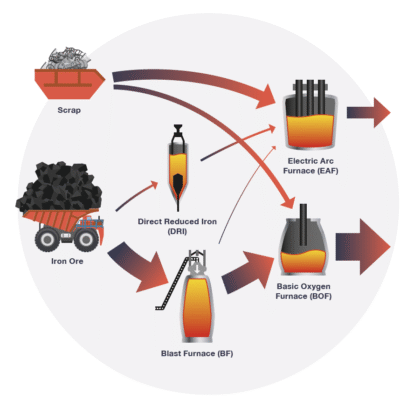
If you read the literature of the European Recycling Industries Confederation (EuRIC) you might get the impression that recycling steel is only possible using electric arc furnaces: [there are] ‘… two […] steelmaking routes, the Blast Oxygen Furnace (BOF) [sic], which relies on iron ore, and the Electric Arc Furnace (EAF), which uses recycled scrap…
-
A ‘sliding scale’ for steel and glass?
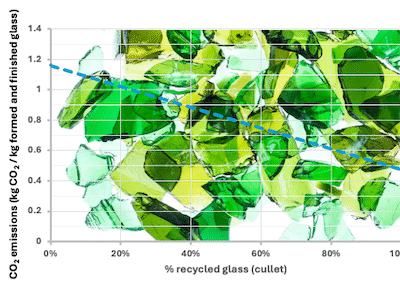
Glass and steel are similar in many ways. They’re both made from raw materials originally mined from the earth: silica sand, trona, limestone and dolomite in the case of glass, iron ore in the case of steel; those raw materials are completely transformed by heating them to around 1500 degrees centigrade; and both glass and…
-
Mining and ResponsibleGlass
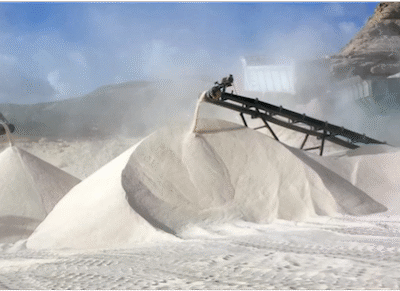
It was great to see ResponsibleGlass and the Initiative for Responsible Mining Assurance (IRMA) announce that they will be working together to address sustainability issues in the glass value chain. This was almost the first public announcement ResponsibleGlass has made. It raises two questions: firstly, why is it so important for ResponsibleGlass to work with…
-

Steel’s methane footprint
How much methane is emitted into the atmosphere each year due to steel making? The answer, surprisingly, seems to be that no one really knows. To date, estimates of steel’s methane emissions have focussed on the sector’s use of ‘metallurgical coal’. Metallurgical coal includes various grades of coal used for coke making (‘coking coal’), as…
-

Steel’s Greenhouse Gas Footprint(s)
So the steel sector emits around 3.7 gigatonnes (Gt) of carbon dioxide (CO2) a year (see ‘6%, 7%, 8%, 9%, 10%, 11%…’), and perhaps another 18.3 million tonnes (Mt) of methane (see ‘Steel’s methane footprint’). But the GHG Protocol lists five more greenhouse gases or groups of gases: nitrous oxide (N2O), hydrofluorocarbons (HFCs), perfluorocarbons (PFCs), sulphur…
-

Methane: steel’s dirty secret?
A few months back I tried to get to the bottom of the wide range of statements about the steel sector’s CO2 emissions. The answer was that the production of crude steel is responsible for emitting around 3.7 Gt of CO2 – 8% to 10% of human emissions (see: ‘6%, 7%, 8%, 9%, 10%, 11%…’). But…
-

Global Recycling Day: the long view
When it comes to recycling, it is worth taking the long view. For the first few thousand years iron and steel recycling meant reworking rather than re-melting. The development of the blast furnace around one thousand years ago made it possible to convert steel scrap into liquid metal. And the first commercial Electric Arc Furnace…
-

All you need to know about steel, scrap and greenhouse gas emissions in just 2 graphs: graph#2
Last week’s graph (see graph#1) started to explore the relationship between crude steel production, scrap generation and the residual demand for iron extracted directly from iron ore. This week’s graph – graph#2 – shows how greenhouse gas emissions for steelmaking vary with scrap use at individual sites. Each dot on the graph is a separate…
-

All you need to know about steel, scrap and greenhouse gas emissions in just 2 graphs: graph#1
Just two graphs tell you everything you need to know about steel, scrap and greenhouse gas emissions. This is the first. Along the bottom, left to right, you have time. It starts in the year 1900 at the left and continues through to the year 2100 at the right. 2024 is about two thirds of…
-

A Montreal Protocol for Steel
The steel sector emits more than 4 billion tonnes CO2 equivalent of greenhouse gases every year, 90% of which is from coal-based steelmaking. That has to stop for the world to stand any chance of limiting climate change to 2 degrees, let alone 1.5. Steelmakers know this. Governments know this. Civil society knows this. The…

Categories
Recent Posts
- “You can only recycle steel in an EAF” – Really?
- A ‘sliding scale’ for steel and glass?
- Mining and ResponsibleGlass
- Steel’s methane footprint

Tags
Chain of custody Claims Climate change Cullet GHG Glass Methane Mining Organisational development Research Scrap Standards Steel Water