
Scrap
-
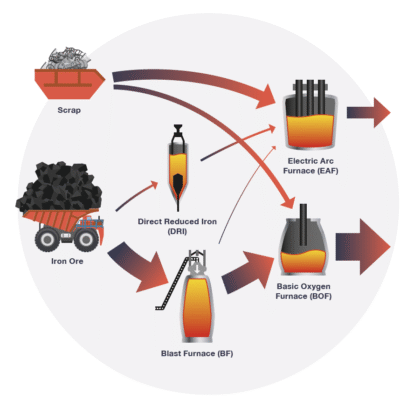
“You can only recycle steel in an EAF” – Really?
If you read the literature of the European Recycling Industries Confederation (EuRIC) you might get the impression that recycling steel is only possible using electric arc furnaces: [there are] ‘… two […] steelmaking routes, the Blast Oxygen Furnace (BOF) [sic], which relies on iron ore, and the Electric Arc Furnace (EAF), which uses recycled scrap…
-
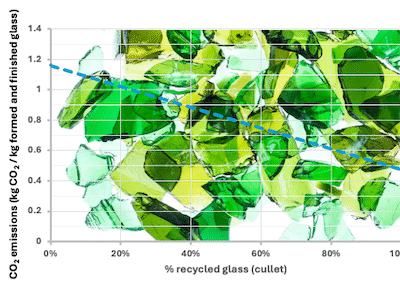
A ‘sliding scale’ for steel and glass?
Glass and steel are similar in many ways. They’re both made from raw materials originally mined from the earth: silica sand, trona, limestone and dolomite in the case of glass, iron ore in the case of steel; those raw materials are completely transformed by heating them to around 1500 degrees centigrade; and both glass and…
-

Global Recycling Day: the long view
When it comes to recycling, it is worth taking the long view. For the first few thousand years iron and steel recycling meant reworking rather than re-melting. The development of the blast furnace around one thousand years ago made it possible to convert steel scrap into liquid metal. And the first commercial Electric Arc Furnace…
-

All you need to know about steel, scrap and greenhouse gas emissions in just 2 graphs: graph#2
Last week’s graph (see graph#1) started to explore the relationship between crude steel production, scrap generation and the residual demand for iron extracted directly from iron ore. This week’s graph – graph#2 – shows how greenhouse gas emissions for steelmaking vary with scrap use at individual sites. Each dot on the graph is a separate…
-

All you need to know about steel, scrap and greenhouse gas emissions in just 2 graphs: graph#1
Just two graphs tell you everything you need to know about steel, scrap and greenhouse gas emissions. This is the first. Along the bottom, left to right, you have time. It starts in the year 1900 at the left and continues through to the year 2100 at the right. 2024 is about two thirds of…
-

Steel and the infinitely washable T-shirt
It can seem that every steelmaker on the planet brags that steel is ‘infinitely recyclable’ – but is it? Well, yes and no. In one sense steel – or more accurately, iron – really is infinitely recylable. Nuclear reactions aside iron atoms are indestructable. It doesn’t matter how many times you roll, cut or cast…
-

How Ship Plates Become Millions of Nails
Awesome, terrifying, and exactly what it says on the tin. Watch as recovered ship plates are cut, melted, extruded and stamped to become millions of nails. Fear, as workers jump and dodge thrashing lines of red hot metal. I’ve been trying to work out what the stats on steel recycling are including, and what they…
-

Calculating the recycling rate – the devil in the detail
The recycling rate is the proportion of a material that is recovered and recycled. If 90% of steel cans are recovered and recycled after they have been used, then the end-of-life recycling rate for steel cans would be 90%. In a previous post ‘Unrecovered or unrecoverable? The fate of end-of-life steel’ I pointed out the…
-

Recycled content – giving it 110%
Footballers are famous for “giving it 110%”. But can steel have 110% recycled content? Recycled content is the proportion of recycled material in a new product. If I am making steel cans, and half of the steel I use is scrap and half is made directly from iron ore, then the cans have 50% recycled…
-

Any old iron?
What do Peter Sellers and Kermit the Frog tell us about the recovery and recycling of end-of-life ferrous scrap? Well, they’ve both recorded versions of music hall legend Harry Champion’s catchy 1911 classic ‘Any Old Iron’. Well worth checking out all their versions if you have a spare moment – links at the end of…

Categories
Recent Posts
- “You can only recycle steel in an EAF” – Really?
- A ‘sliding scale’ for steel and glass?
- Mining and ResponsibleGlass
- Steel’s methane footprint

Tags
Chain of custody Claims Climate change Cullet GHG Glass Methane Mining Organisational development Research Scrap Standards Steel Water